South Chicago
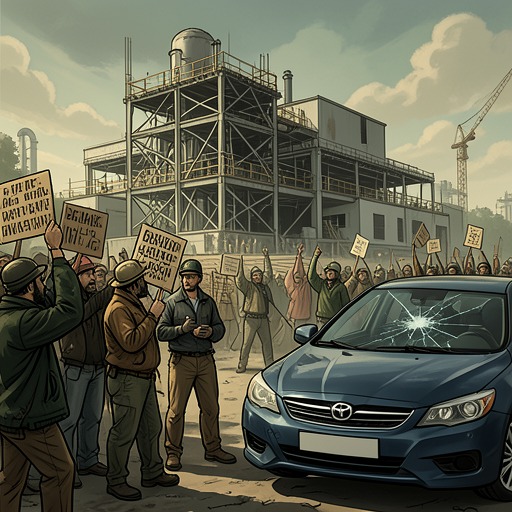
Blood ShotSouth Chicago is the neighborhood V. I. Warshawski returns to in order to investigate, and the place where personal memory meets an industrial landscape still bearing the costs of its transformation. Its closed or declining factories, polluted waterways, and maintained but deteriorating homes make the effects of economic change visible at street level; its history also connects those conditions to the lives and conflicts at the center of her inquiry.
Geography and visible contrasts
Approaching from the north on Route 41, V. I. Warshawski passes from Lake Shore Drive’s view of Lake Michigan and expensive high-rises into a markedly different landscape. At Seventy-ninth Street, the lake seems to vanish behind the extensive grounds of USX South Works, whose weed-choked yards occupy the stretch between the road and the water. In the February air, the works’ pylons, gantries, and towers appear through smoke. The contrast is abrupt: beaches and high-rises give way to landfill and worn factories, with the industrial site interrupting any simple image of Chicago as a prosperous lakeside city.
The neighborhood’s residential streets offer a second, more complicated picture of decline. Some bungalows have damaged siding, peeling paint, or cracked and sagging front steps. Yet their windows remain whole, the yards are free of debris, and the homes are still cared for. The contrast matters: poverty and disrepair have reached the area, but the residents’ attention to their houses registers a refusal to let hardship erase local standards of care. The neighborhood is not represented only as ruin; the houses show people maintaining a life within it.
Home, memory, and community
The landscape is also measured against Warshawski’s memories of a time when South Chicago supported a vast industrial workforce. She recalls eighteen thousand men leaving its tidy homes each day for USX South Works, Wisconsin Steel, the Ford assembly plant, or the Xerxes solvent factory. Freshly painted trim and the regular appearance of new Buicks and Oldsmobiles belong to that remembered prosperity. By the time of her return, South Works is on strike and Wisconsin Steel is padlocked and rusting. The change is not an abstract economic statistic alone: it marks the altered relation between the neighborhood’s homes and the workplaces that once organized daily life.
Houston Street brings the larger history close to Warshawski’s family. She had last been on the block in 1976, when her father died and she returned to sell the family house. She saw Louisa Djiak and Louisa’s fourteen-year-old daughter Caroline Djiak then; Caroline followed Warshawski with determination and tried basketball, though her height kept her off the first squad. Warshawski had not spoken to the other neighbors who knew her parents since that visit. Their memories preserve contrasting judgments of her parents: genuine grief for her gentle, good-humored father, and a grudging respect for her mother, Gabriella Warshawski, whose thrift and unconventional decisions had once drawn criticism. Returning to the block therefore means confronting both a changing neighborhood and a past from which Warshawski has been absent.
South Chicago’s social boundaries are made explicit in the description of East Side, a predominantly white neighborhood east of South Chicago and separated from the city by the Calumet River. Its residents are described as leading parochial, insular lives; Louisa’s parents still live in the house where she grew up. Louisa’s limited experience of the wider city helps explain the importance of this local geography in the search for her past. The river is not just a physical feature: it marks a boundary around a world in which movement and social contact have been restricted.
Industrial making and environmental damage
The Calumet landscape did not become industrial by accident. More than a century before the events of the novel, the Army Corps of Engineers and George Pullman set out to turn the marshes between Lake Calumet and Lake Michigan into an industrial center. Andrew Carnegie, Judge Gary, and other industrialists also contributed to the transformation over several decades. The area, about four miles square, was filled with dirt and clay dredged from Lake Calumet, along with phenols, oils, ferrous sulfide, and many other substances. This account ties the present landscape to a long history of deliberate development: the marsh was remade to serve industry, and industrial residue became part of the ground on which that development depended.
Warshawski’s drive through the district presents the consequences in images that resist the reassuring language of progress. After leaving the expressway at 103rd Street, she feels as if she has landed on the moon or returned to a devastated earth. Around Lake Calumet, oily mud replaces familiar signs of life; she sees no trees, grass, or birds, only an occasional feral dog with its ribs showing. The Xerxes plant, situated in the former swamp near 110th Street east of Torrence, stands as a specific part of this industrial terrain. Its old building dates from the early 1950s, and the faded pink sign, once royal purple, still calls it King of Solvents. The ruined color of the sign condenses the wider contrast between industrial self-presentation and a landscape marked by decay and contamination.
Water links this environmental history to Warshawski’s own past. At Eighty-ninth Street, she turns west toward the Calumet River, remembering that she and her friends once defied their parents by swimming there. On returning, she is sickened by the thought of putting her face into its filthy water. The river has not changed only in appearance; it has changed what a remembered childhood activity means. Later, when Warshawski explains Nancy Cleghorn’s death to Bobby Mallory, she uses a city map to show Houston Street, the route down to the Cal Industrial District, and the wetlands where Nancy was found. The industrial zone and wetlands are thus both part of the geography of the investigation, not remote scenery outside the city’s human story.
Work, politics, and local institutions
The neighborhood’s economic and environmental conditions are also connected to local political disputes. Caroline Djiak works with SCRAP, where Nancy Cleghorn is environmental affairs director. When Warshawski seeks Nancy, she learns that Nancy has moved to South Shore, while her mother, Ellen Cleghorn, remains on Muskegon. The distinction between Nancy’s home and the neighborhood she works on underscores the practical networks through which local environmental and community concerns are pursued. Nancy’s work brings those concerns into contact with political offices and industrial interests.
That conflict appears in the explanation Art Jurshak gives about keeping his relationship with Nancy secret. His father, Art Jurshak Sr., opposed SCRAP, which he believed was trying to take over his ward by criticizing conditions such as broken sidewalks and unemployment in South Chicago. He also blamed the lack of federal money reaching white ethnic neighborhoods after Washington took charge. Warshawski recognizes the limits of this account: the neighborhood’s decline had begun under Mayor Daley and continued under later administrations, while Art Jurshak Sr. had been alderman throughout those years. The disagreement exposes a recurring local tension between criticism of neglect and efforts to assign responsibility for it.
Warshawski’s investigation takes her through ordinary neighborhood institutions as well as political ones. At the ward offices on Avenue M, she waits among favor-seekers and workers playing checkers, leaves her card for young Art, and returns after buying a meatball sandwich and beer at a bar near Ewing. At Ninety-third and Commercial, she visits the grimy stone building of Ironworkers Savings & Loan, where her mother opened her first savings account when she was ten. The vaulted ceiling that had seemed magnificent in childhood now looks merely dirty, and the teller’s cage no longer towers above her. The bank’s officer describes a privately owned institution that renegotiates loans for longtime customers in hard times. These encounters place economic hardship and community continuity in specific rooms and streets: the neighborhood is shaped not only by factories, but also by the local institutions through which residents seek help, credit, or political attention.
Narrative significance and aftermath
South Chicago functions as both the setting of Warshawski’s return and a record of changes that cannot be separated from the investigation. The route from the lakefront to the factories, from Houston Street to the river and wetlands, repeatedly draws her through a landscape she recognizes but no longer experiences as she did in childhood. The contrast between remembered swimming and polluted water, between former factory employment and shuttered works, and between decaying houses and carefully kept yards makes the neighborhood’s transformation concrete. The narration’s return to particular streets and landmarks gives environmental damage and economic decline the weight of lived memory rather than treating them as distant background.
The inquiry does not end with Warshawski’s mastery of the neighborhood’s problems. After the danger surrounding the case and the information she obtains about Art Jurshak’s insurance fraud involving Xerxes, she decides she cannot continue pursuing every loose end. She leaves Ron Kappelman’s possible role unresolved, despite Bobby’s accusation that he had been passing information about her whereabouts to Jurshak, and relies on the state’s attorney to take up matters when Jurshak and Steve Dresberg come to trial. Her withdrawal does not resolve South Chicago’s industrial or political conditions. Instead, it emphasizes the limits of one investigator’s capacity: the neighborhood’s history and pollution exceed the closure that a single case can provide.